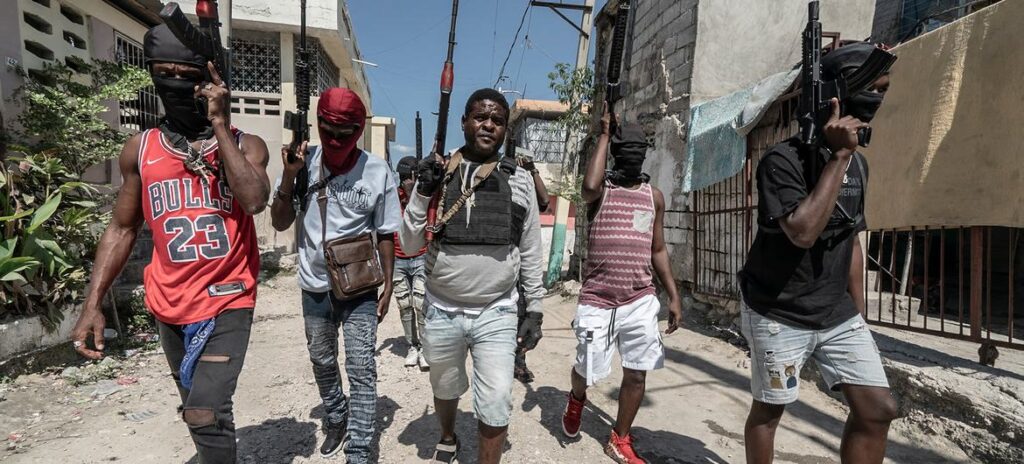
It is 2am when the gunshots begin. The neighbourhood in rural Haiti is asleep. “Pow, pow, pow – quick gunfire coming towards us from all directions,” says Merçide Daniel, a 45-year-old mother of four. “It was the Gran Grif gang coming to take over our neighbourhood and turn it into a base.”
Dozens of men wearing civilian clothes and bandanas, with rifles slung around their necks, swarm through the village, shooting indiscriminately.
Residents attempting to flee are gunned down as they run. Others are dragged from their homes. Some are dispatched at close range.
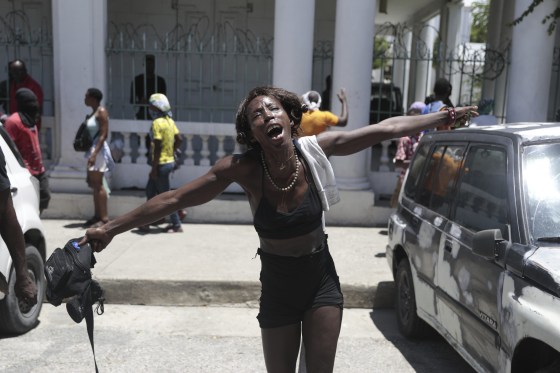
“They were shooting at us, attacking. I ran to hide in the bushes and when I looked back, they had set everything on fire,” says Daniel, describing the 29 March attack on the settlement of Jean-Denis by the Gran Grif, one of Haiti’s most feared criminal organisations.
Home after home is set ablaze, some with residents trapped inside. By morning, thick columns of smoke still rise from houses, the once-colourful painted buildings reduced to charred shells.
By the morning, dozens of bodies lie scattered across the roads. The crack of gunfire continues in the distance.
Those who survive wander past body after body, filming the devastation and looking for those they know. In one cluster of bodies, a man wearing a khaki-coloured top lies sprawled on the ground, with cuts to his face and gunshot wounds to his chest and arm. Blood stains the earth beneath him.
Opposite him lies another man in blue shorts, with a seeping neck wound. Nearby, a third man wearing a striped shirt lies on his back, blood pooling around his head.
A man in a blue hoodie sprawls motionless on the ground, his white cap fallen beside him. Another man, dressed in red, has been killed while crouching beneath a makeshift shelter or porch. His legs are still folded beneath him.
An elderly woman, 80-year-old Marie Elvire Louis, lies wrapped in a plaid blanket. The mother of five died after being shot in the neck and chest outside her front door. Near her, a man identified as Kenold François, a father of four, lies prone and drenched in blood. He was shot several times in the abdomen in the yard of his house.
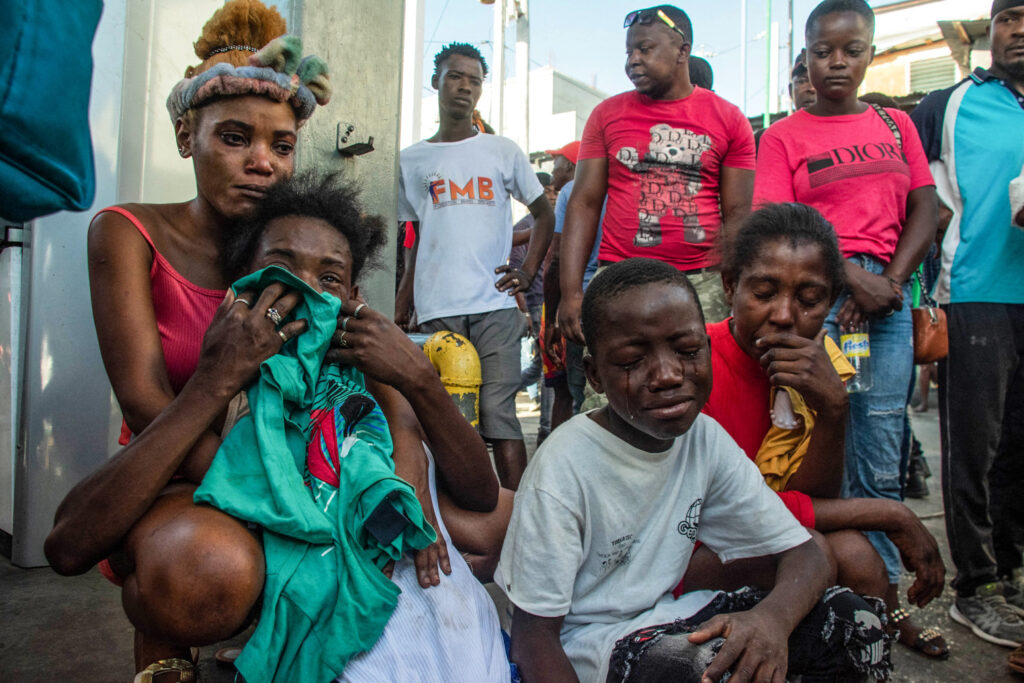
Five members of Daniel’s family were murdered in the violence: two uncles, an aunt and two cousins – three killed trying to escape, the other two burned alive in their houses. “I had never seen anything like this before,” she says. “It was a massacre.”
For years, unrelenting gang warfare has ravaged Port-au-Prince, with cartels taking control of large stretches of the capital and driving the near-total collapse of state authority.
Now seeking to extend their reach, they are pushing into Haiti’s rural heartland, which was once largely insulated from the violence, attacking farming communities, seizing key roads and massacring entire villages.
Using dozens of verified videos, photographs, witness testimony and satellite imagery, the Guardian has reconstructed the massacre at Jean-Denis, exposing the extraordinary scale of the bloodshed that is spreading far beyond Haiti’s urban areas. At least 70 civilians were killed in the village, and thousands were forced to flee.
The victims spanned generations – old age or youth was no protection. Estimable Fils-Aimé, 85, a father of six, was hiding in his house when gang members set it on fire. He was burned alive. Oldy Thomas, 28, a father of one, was trying to flee when he was struck by several bullets.
Berlancia Dor, eight, was among the youngest to be killed. She was escaping with her family when she was shot in the chest, dying instantly. Thélomène Thelot, 62, a mother of five, was hit by three bullets while in the garden of her home. She was subsequently lynched by the attackers.
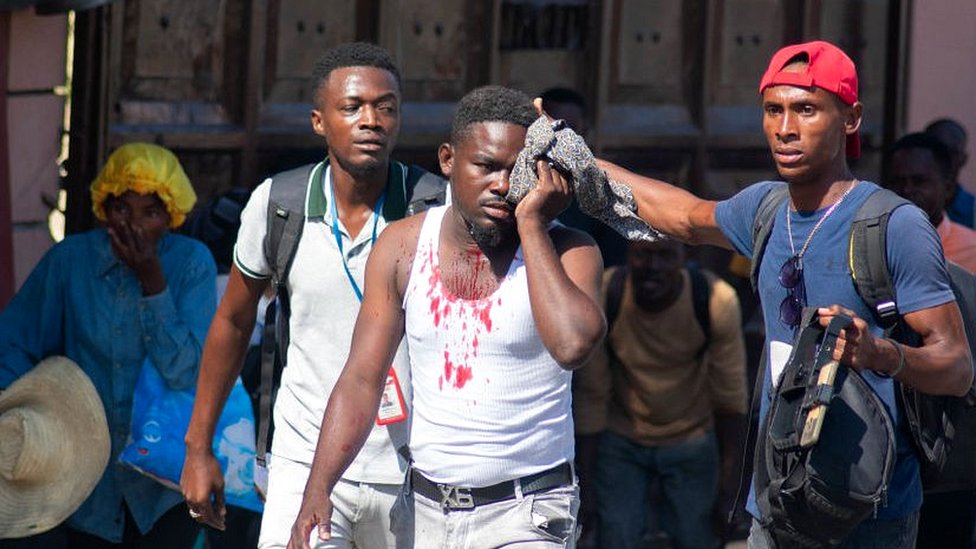
“We are not safe – we have lost everything,” says Daniel.
Gerno Théophile, 61, lost six family members and his home, which was burned down in the attack. He says he is now sleeping on the streets as there has been little state support. “I am so very angry,” he says.
In Artibonite, the region where the Jean-Denis massacre occurred, violent incidents involving gangs and vigilante groups have risen from 39 in 2021 to 238 in 2025, according to data from the Armed Conflict Location & Event Data project (ACLED), a conflict-monitoring organisation.
In Centre, a landlocked department in the middle of the country, violent incidents have increased from seven to 111 over the same period. Analysts also warn of an emerging threat in the country’s south-east.