
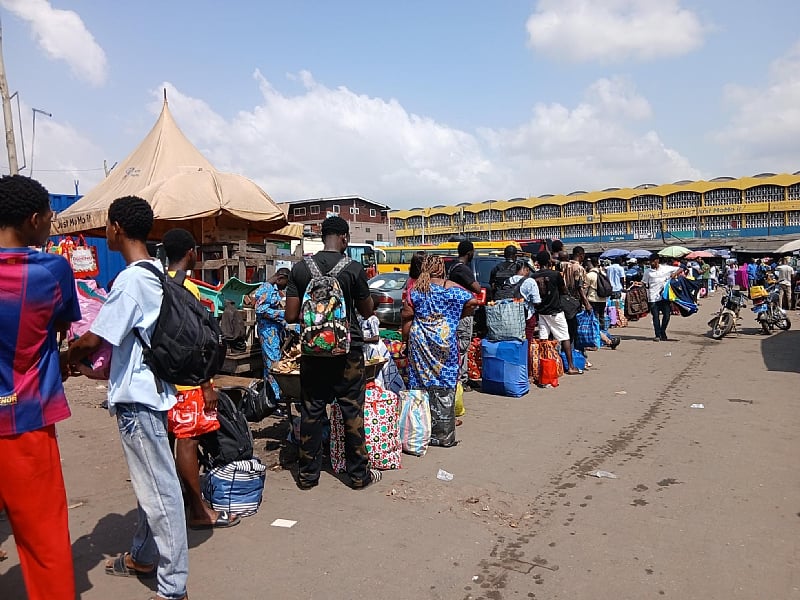
Thousands of commuters across the national capital continue to face long delays and severe difficulties in travelling to and from work, as shortages of commercial vehicles, heavy traffic congestion and deteriorating road conditions disrupt daily movement.
The situation has worsened with the onset of the rains, leaving several key roads in and around Accra difficult to navigate and further affecting public transport operations.
Commuters from areas such as Lashibi, Nungua, Teshie, Labadi, Kasoa, Dawhenya, Kpone Barrier, Tema Community 25, Pokuase and Nsawam to the Central Business District and other parts of the capital are among the hardest hit.
Long queues, overcrowded terminals, rising fares and extended travel times have become a daily experience.
Earlier this year, The Ghanaian Times reported on the exploitation of commuters by some trotro operators through the “tot-tot” system, which prompted an intervention by National Security.
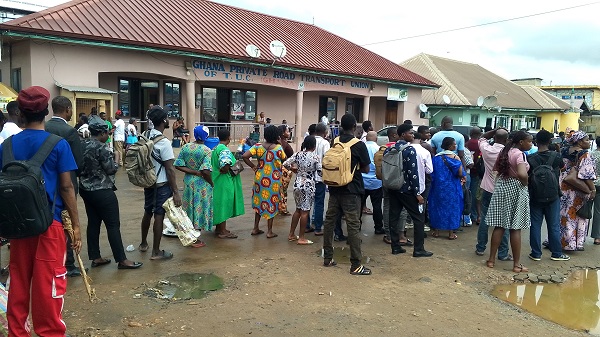
However, more than four months later, the practice persists, leaving commuters to continue bearing the brunt.
From Lashibi, by about 5:30 a.m. on Tuesday, bus and lorry stations along the Lashibi-Nungua-Teshie-Labadi corridor towards the Central Business District and Kwame Nkrumah Circle were already crowded with commuters searching for transport.
The growing number of passengers, coupled with the limited availability of commercial vehicles, has made commuting increasingly difficult.
At several stations, commuters were forced to join long queues and compete for the few available vehicles, with pushing and jostling becoming common.
Some commuters who spoke to The Ghanaian Times said they often spent additional hours waiting by the roadside and frequently arrived late at work.
On the Circle-Nsawam stretch, similar scenes, with large crowds of commuters at Doboro, Samsam, Medie, Satellite, Kpobiman, Sarpeiman, Amasaman and Pokuase, all struggling to find transport.
Transport operators attributed the situation to the limited number of vehicles on the route, the poor condition of sections of the road, particularly around Achimota near the overhead bridge, Amasaman, Hebron, Doboro and Sarpeiman as well as persistent traffic congestion.
As a result, a journey from Nsawam to Circle, which would ordinarily take less than one and a half hours, now takes more than three hours, leading to significant inconvenience and loss of productivity.
A civil servant, Mr Bismark Amponsah, said the situation was stressful, explaining that he had been waiting for more than an hour and a half after arriving at the roadside at 6 a.m. without securing a vehicle.
A trader, Ms Martha Obiyaa, also said she had waited for over two hours without success and might have to return home as there was no sign of getting transport anytime soon.
A driver, Mr Yaw Ansah, explained that many drivers had abandoned the Circle-Nsawam route due to the poor state of the road, which has increased maintenance costs and made operations difficult. He appealed for urgent rehabilitation of the road.
From Kasoa, hundreds of commuters across Kasoa, Mallam, Gbawe, Pokuase and Ablekuma were also experiencing long waiting times due to the limited number of commercial vehicles.
A visit to major terminals showed long queues of passengers, with many waiting between one and three hours to secure transport.
Commuters also complained about paying fares above approved rates.
At the Kaneshie-Kasoa station, some passengers paid GH¢15 instead of the approved GH¢8.50, while others travelling from Circle to Kasoa paid more than GH¢20 during peak periods.
Passengers further expressed concern about the growing practice of short-loading, where drivers transport passengers only part of the journey, forcing them to join new queues to continue.
Drivers attributed the situation partly to heavy traffic congestion, which reduces the number of trips they are able to make each day.
From Lapaz, commuters travelling towards 37 and Madina were among the worst affected. Between 6 a.m. and 9 a.m., large numbers of commuters lined up along the George Walker Bush Highway, opposite the Las Palmas traffic light, in search of transport.
The situation has also led to unregulated fare increases.
For instance, a trotro fare from Lapaz to Madina, which is GH¢7, has risen to GH¢10 regardless of where a passenger alights.
Some frustrated commuters called on the state to take greater control of the transport sector to curb what they described as exploitation by private transport operators.