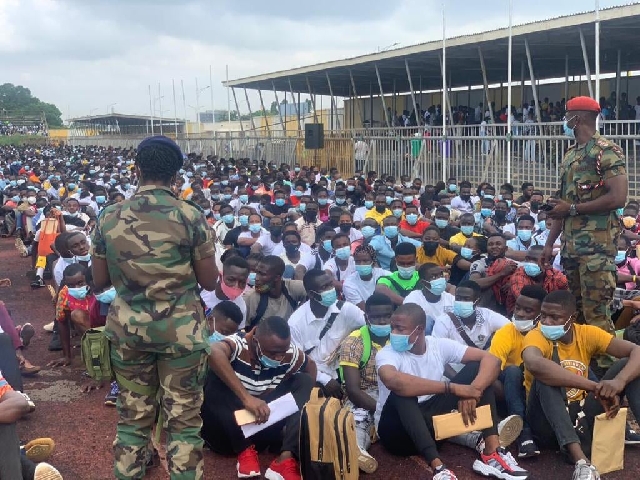
The Chairperson of the Government Assurance Committee of Parliament, Dominic Nitiwul, has advised the Minister for the Interior, Muntaka Mohammed-Mubarak, to take immediate steps to reach out to the 1,300 persons who tested HIV positive during the recent recruitment exercises into various security agencies.
He said if Mohammed-Mubarak and the various security agencies contacted those affected, it would help them to know their status, seek counselling, and undergo early treatment. That, he said, would help the recruits, who might still not be aware of their status, to stop spreading the virus.
Number huge and scary
The Chairperson, who gave the advice when the Interior Minister appeared before the committee on July 7, said: “Please, find a way of reaching out to these people as the number is huge and scary.”
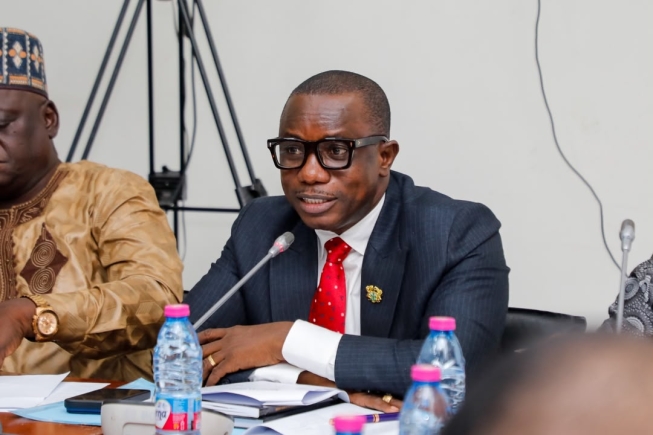
Dominic Nitiwul, the Chairperson of the Government Assurance Committee, giving his advice when the Interior Minister appeared before the committee
Test results not communicated yet
The minister had appeared to answer questions pertaining to several assurances he made in Parliament to implement a number of policies and programmes of the ministry from 2025.
During the interaction, Mr Muntaka told the committee that out of the 100,000 persons who went through the recruitment aptitude and medical tests, 1,300 tested positive for HIV. He, however, said the results of the tests had not yet been sent directly to applicants “because we do not want the shock.”
He said a contact had rather been provided to enable the recruits to personally contact them and undergo some orientation before knowing their status. Based on the World Health Organisation guidelines, he said there were certain ailments that “you just do not throw it on a person’s face that you have hepatitis B and you have HIV.”
Question
The Minister’s revelation came after a member of the committee and the MP for Ahanta West, Mavis Kuukua Bissue, sought to know if all those applicants, especially those who tested for HIV and drug issues, had been contacted to go for counselling and medical treatment.
Mr Nitiwul recalled that during his time as Minister for Defence, there were quite a few people who had tested positive for HIV during one of the recruitment exercises. To curb the spread of the virus, he said: “We called them, counselled them and told them, and it is important you do that too.”
“Because trust me, if it is a boy, he may have a girlfriend, and if it is a girl, she may have a boyfriend, and if they are not aware, trust me, the next time this 1,300 figure will jump to 10,000 or 20,000,” he said. “So you have to find a way of assuring them so that they can treat themselves because getting HIV is not the same as getting AIDS.”
The Chairperson pointed out that once a person living with HIV continued to take their drugs, they could live a normal life. “It is not like before, when the disease was a death sentence. No. If the person has HIV and has not already developed into AIDS, and the person continues to take the drugs, the person will actually live a normal life and give birth. And it will come to a time when the person continues taking the drugs, and they cannot infect people, but if you do not inform them, first, they will spread it, and secondly, they will develop into AIDS and die early,” he said.
Useful Advice
Heeding the advice of the committee’s Chairperson, the minister described Mr Nitiwul’s prompting as “very useful advice.”
“Yes, you are right because this is a public health issue, and it is something that we should not gloss over because it will lead to many innocent people getting it. So, advice is well taken, and I assure you that we will try what we can to help, especially those with HIV, as it is a public health risk,” he said.