
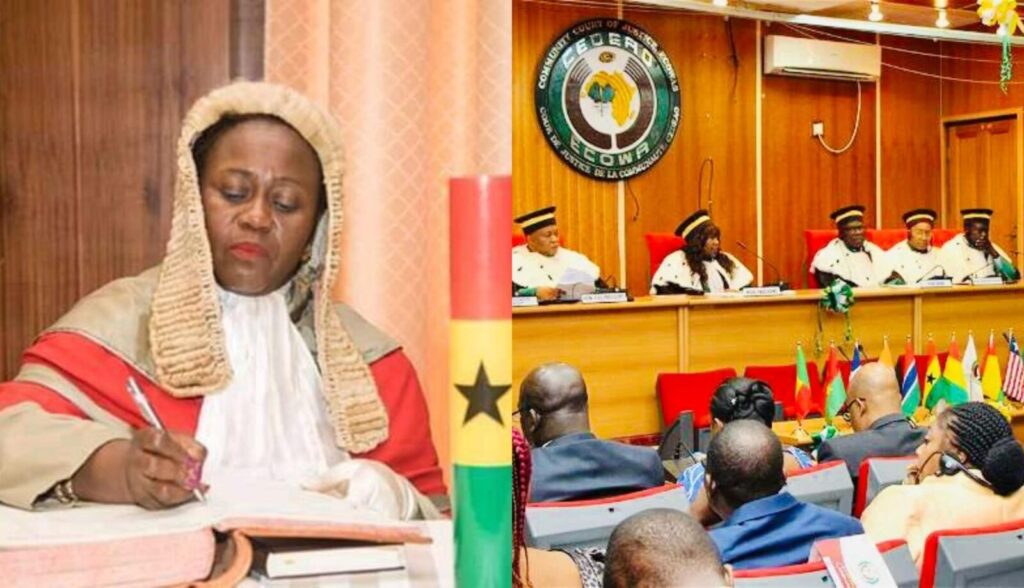
Former Chief Justice Gertrude Sackey Torkornoo has lost her legal action at the ECOWAS Community Court of Justice (CCJ) challenging her removal from office by the state.
The court yesterday dismissed all seven claims of human rights violations by Justice Torkornoo in the process leading to her removal.
In an abridged judgment delivered yesterday, the court held that Ghana did not violate Justice Torkornoo’s rights to a fair hearing, dignity, information and work under the African Charter on Human and Peoples’ Rights.
Consequently, the court dismissed all reliefs sought by the former Chief Justice, including her request for reinstatement as Chief Justice and Justice of the Supreme Court, access to reports connected to the proceedings leading to her removal, and compensation of $10 million for alleged moral and reputational damage.
Alleged violations
Justice Torkornoo had argued that the process leading to her suspension and removal violated her rights because the President commenced consultations with the Council of State and determined that a prima facie case had been established before she was notified of the petitions.
She also challenged the competence and impartiality of the five-member committee constituted to investigate the petitions, alleged procedural unfairness during the inquiry, claimed that her suspension and removal violated her right to work and contended that she had been subjected to undignified treatment throughout the process.
The issues for determination included whether her right to a fair hearing was violated during the prima facie determination and subsequent proceedings before the inquiry committee; whether the committee was competent and impartial; whether the committee’s findings were supported by evidence; whether her suspension and removal violated her right to work; and whether she was subjected to undignified treatment.
Others were whether Ghana violated the legal principle of lis pendens (suit pending) by continuing with the process while the ECOWAS case was pending, and whether her right to information was breached.
Fair hearing
Making a determination on the issue of fair hearing, the ECOWAS Court held that the presidential determination of a prima facie case constituted a preliminary filtering mechanism rather than an actual determination of rights.
The court explained that the stage at which the applicant’s right to be heard crystallised was when the five-member committee was constituted, and the petitions were referred to it for determination.
According to the court, evidence before it showed that Justice Torkornoo had been furnished with copies of the petitions and had submitted written responses before the prima facie determination was concluded and before the committee was established.
“Accordingly, the court finds that the respondent did not violate the applicant’s right to be heard under Article 7 of the African Charter,” it held.
The court also rejected claims that the lawyers of Justice Torkornoo were excluded from proceedings, and found that — viewed as a whole — the inquiry afforded her a meaningful opportunity to present her defence.
It further dismissed complaints relating to the committee’s choice of procedural rules and the failure of petitioners to testify, holding that such matters fell within the domain of Ghana’s domestic legal system.
Committee
On allegations that the committee that recommended her removal was incompetent and also impartial, the court held that Justice Torkornoo failed to establish actual bias or a real likelihood of bias on the part of committee members.
It held that the fact that some members of the committee had previously participated in unrelated judicial proceedings involving some petitioners did not render them incapable of fairly determining the petitions.
The court also declined to entertain arguments regarding whether some committee members had taken the required constitutional oaths, stating that such questions were matters for Ghanaian courts to determine.
Findings and removal
The court also declined to review the merits of the committee’s findings that formed the basis for Justice Torkornoo’s removal.
It held that doing so would require it to reassess evidence and review factual and legal conclusions reached by a national body, effectively amounting to exercising appellate jurisdiction over domestic proceedings, which was not within the purview and mandate of the ECOWAS Court.
With respect to her removal from office, the court held that her suspension and dismissal were carried out in accordance with constitutional procedures and did not amount to a violation of her right to work.
It further added that the former CJ had been informed of the allegations against her, had responded to them and had been afforded the opportunity to defend herself before the committee.
“It was on the basis of the findings and recommendations of the committee that the applicant was dismissed from office,” the court stated.
The court further accepted Ghana’s argument that her membership of the Supreme Court and other superior courts flowed from her position as Chief Justice and, therefore, no separate removal proceedings were required.
Dignity claim
The former Chief Justice further alleged that she had been subjected to degrading treatment during the proceedings, such as body searches, restrictions on family members, surveillance measures and the choice of venue for the hearings.
She also argued that media coverage of the proceedings exposed her to public ridicule and damaged her reputation locally and internationally.
However, the court found that the security measures adopted during the proceedings were reasonable and proportionate given the confidential nature of the inquiry.
It held that restrictions on electronic devices, security screening procedures and limitations on attendance by family members did not amount to a violation of her dignity.
The court further held that no evidence had been presented to support allegations that the venue of the hearings had been selected to traumatise or psychologically undermine her.
On media coverage, the court observed that holders of high public office inevitably attract a higher degree of public scrutiny and criticism because of the public interest associated with their positions.
It, therefore, found no violation of Article 5 of the African Charter.
Right to information
On the issue of access to information, the court acknowledged that Justice Torkornoo was entitled to receive the committee’s report and related records to enable her to exercise any rights available under Ghanaian law.
However, it found no evidence that she had formally requested the report and been denied access.
The legal dispute stemmed from petitions to remove Justice Torkornoo from office under Article 146 of the 1992 Constitution.
Following consultations with the Council of State and a determination that a prima facie case had been established, President John Dramani Mahama suspended the Chief Justice and constituted a five-member committee chaired by Supreme Court Justice, Justice Gabriel Scott Pwamang, to investigate the petitions.
While the committee’s work was ongoing, Justice Torkornoo filed a suit at the ECOWAS court, alleging violations of her fundamental human rights and seeking, among other reliefs, $10 million in compensation.
In November 2025, the ECOWAS court dismissed her application for provisional measures intended to halt the committee’s proceedings, but affirmed its jurisdiction to hear the substantive case.
Subsequently, after her removal from office on September 1, 2025, Justice Torkornoo applied to amend her suit to challenge her dismissal as Chief Justice and as a Justice of the Supreme Court.
In a ruling delivered following proceedings on January 30, 2026, the ECOWAS Court granted the application, holding that the amendment would allow all issues arising from the suspension and removal to be determined in a single action.